
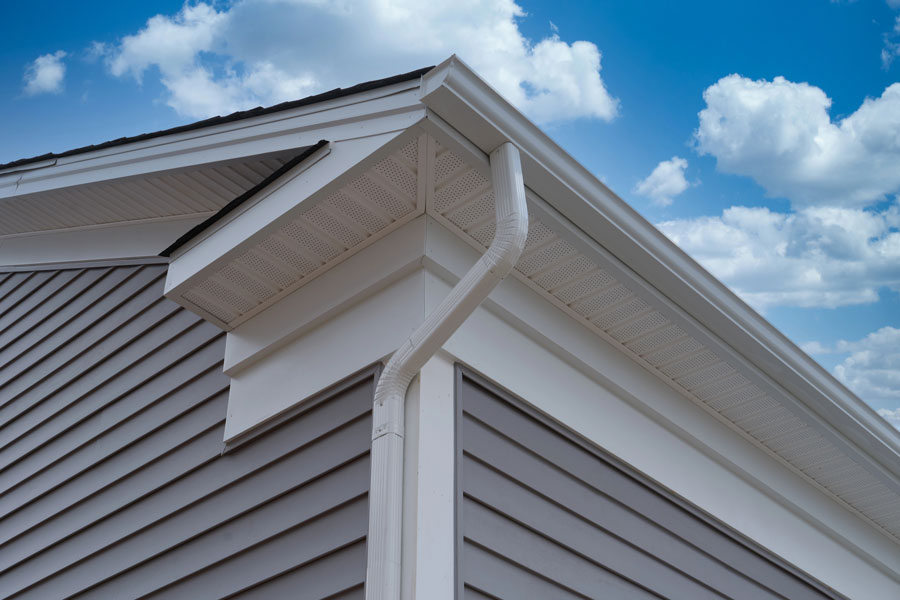
Eavestroughs, soffits, and fascia don’t get much attention until something goes wrong — usually a leak, a stain on the fascia board, or water pooling next to the foundation after a big storm. In Burlington, three local factors make this system work harder than it does further inland: wind-driven rain off Lake Ontario, freeze-thaw cycles that can cause ice damming along the roofline, and mature tree cover in neighbourhoods like Aldershot and Roseland that keeps gutters loaded with leaves and seed pods well into late fall.
What Each Component Actually Does
Eavestroughs (gutters) catch roof runoff and route it to downspouts, away from your foundation. Soffits are the panels under the roof overhang — beyond covering the rafter tails, they ventilate the attic, which matters for both summer heat buildup and winter ice damming. Fascia is the board the eavestroughs are fastened to, running along the roof edge; it’s structural for the gutter system, not just trim.
Why Burlington’s Location Matters
Homes closer to the lakeshore see more wind-driven rain, which pushes water sideways under loose fascia and behind poorly sealed end caps in a way that inland homes rarely deal with. Further from the lake, in older neighbourhoods with large mature trees, the bigger issue is volume — leaves and debris clogging eavestroughs faster than a normal cleaning schedule accounts for, leading to overflow that runs straight down the siding instead of through the downspout.
Ice Damming: The Burlington-Specific Failure Mode
When attic heat escapes unevenly through a poorly ventilated soffit system, snow on the roof melts, runs down to the colder eave, and refreezes — building an ice dam that backs water up under the shingles. This is one of the more common winter callouts we get in Burlington, and it’s a soffit ventilation problem as often as it’s a gutter problem. If your eavestroughs are icing up heavily every winter, the fix usually starts in the attic, not at the gutter.
5-Inch vs. 6-Inch Aluminum Eavestroughs
Seamless aluminum is the standard in the GTA because it’s formed on-site to the exact length of your roofline, with no seams to leak along the run. 5-inch troughs are standard for most residential roofs; on larger roof areas or steeper pitches — common on some of the newer builds in Burlington’s Alton Village — 6-inch troughs handle the higher water volume without overflowing during a heavy downpour. We size this based on roof area and pitch, not just what’s already up there.
Signs You’re Overdue for a Look
- Water spilling over the front of the gutter during rain, rather than draining through the downspout
- Visible sagging between fastener points, or a section pulling away from the fascia
- Staining or peeling on the fascia board itself, which usually means water has been sitting against it
- Ice buildup along the roof edge each winter
- Soffit vents that are painted over or blocked with insulation, cutting off attic airflow
Maintenance That Actually Matters
Twice-yearly cleaning — late spring and after leaf-fall — is the baseline for most Burlington properties; homes under heavy tree cover often need a mid-season check as well. Beyond cleaning, the highest-value inspection item is the fascia behind the gutter, since that’s where slow leaks do the most structural damage before they’re visible from the ground.
Need eavestroughs, soffit, or fascia work done properly the first time? See our Burlington eavestrough installation page or request a free assessment.


